

History of Tower, Turret, Town & Church Clocks

History & meaning
The History of Tower, Turret, Town & Church Clocks
Tower clocks, turret clocks, town clocks, and church clocks are more than oversized timekeepers. For centuries, these multi-dial public clocks have marked public life, guided daily schedules, identified important buildings, and helped communities share a common sense of time.
Before private time
Public clocks gave a community one shared reference point.
Before personal watches became common, and long before phones placed exact time in every pocket, the public clock was one of the most useful machines in town. It told people when to gather, when to open, when to close, when to work, when to worship, and when the day had changed.
Why the tower mattered
A tower lifted the clock where everyone could see it and, when fitted with a bell or strike system, where everyone could hear it. That visibility made the clock part of the town’s identity. A town clock, church clock, or turret clock in a public building was not just equipment. It was a public promise that the place was alive, organized, and cared for.
The clock as civic memory
Many public clocks are tied to donors, anniversaries, historic buildings, town centers, school campuses, and local landmarks. Even when the original reason for installation has faded, the clock remains part of the way people recognize the building and remember the community around it.
A short timeline
From striking bells to public dials.
The exact history of each clock is local, but the broad story is familiar: public clocks grew from the need to share time across a town, institution, or working community.
Public time begins with sound.
Early public clocks often announced the hour by bell. In many places, hearing the hour mattered before seeing a dial.
The face becomes public.
As exterior dials became common, a tower clock let people check the time from streets, squares, campuses, and work yards.
Time organizes the day.
Public clocks helped coordinate work shifts, schools, worship, court schedules, transportation, and civic meetings.
The clock becomes heritage.
Today, many tower clocks are valued both as working machines and as visible historic features of important buildings.
How they work
A tower clock is a building-scale machine.
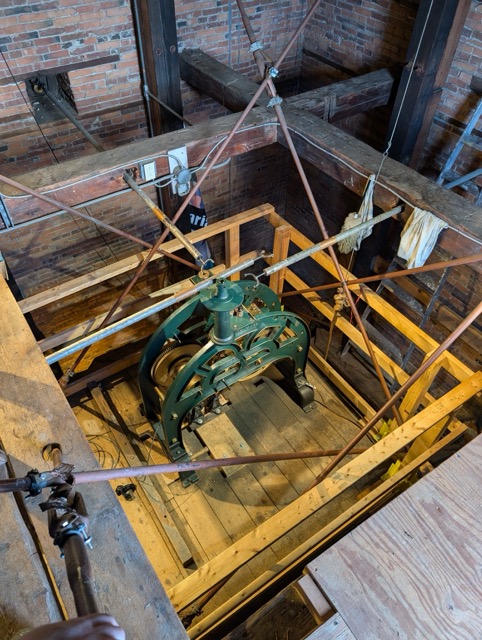
Although every clock is different, many mechanical tower clocks, turret clocks, town clocks, and church clocks share the same basic family of parts: a power source, a regulating system, gear trains, motion work, hands, dials, and sometimes a bell or strike system. The machine may sit far away from the dial it drives, connected through rods, shafts, gearing, cables, or linkages.
- Weights, cables, springs, or motors provide power.
- The escapement and pendulum regulate the release of that power.
- Gear trains transmit motion to the hands and strike system.
- Large exterior hands face weather, wind, ice, and seasonal load.
- Bell, hammer, and strike systems add sound to public timekeeping.
What they mean
Why towns and institutions still care.
A tower clock is one of the few mechanical objects that belongs to a whole community. People may not know the movement inside the tower, but they know whether the face is right, whether the bell sounds, and whether the building still feels cared for.
Public trust
A working public clock signals reliability. It tells residents, visitors, students, parishioners, and staff that the building is being maintained.
Local identity
Clock faces appear in memories, photographs, town centers, school campuses, and historic districts. They become part of how people recognize a place.
Donor and civic value
Many clocks were funded, restored, or maintained through public effort. Keeping them working respects that earlier investment.
Architecture
The dial, hands, bell, and tower opening often belong visually to the building. Repair should consider the clock and the structure together.
Mechanical heritage
A tower clock can show generations of engineering decisions, repairs, maker marks, and adaptations. That history should be understood before parts are replaced.
Practical use
Even in a digital age, a large public clock still helps orient people, mark gatherings, and give a town center or campus a familiar rhythm.
Repair and preservation
Restoring a public clock starts with understanding what is original, what is worn, and what the building needs.
Responsible tower clock work is not only about making the hands move again. A serious evaluation looks at the movement, dial, hands, motion work, bell or strike system, winding method, access route, weather exposure, and the building’s goals.
Preserve where it is responsible.
Original parts should be preserved when they are mechanically sound and can be repaired safely. That may involve cleaning, pivot and bushing work, adjustment, lubrication, part repair, or careful reassembly.
Modernize only with a reason.
Automatic winding, controls, replacement parts, or dial improvements may make sense for some public buildings, but the goal should be clear: reliability, safety, access, preservation, or public use. The best plan explains why each choice is recommended.
Common questions
History, repair, and public-clock decisions.
These answers help owners and committees think about a tower clock as both a machine and a public feature.
Why did so many towns put clocks in towers?
A tower gave the clock visibility and reach. People could see the dial from a distance and hear the bell or strike across a wider area, which made the clock useful to the whole community.
Is a tower clock worth repairing if people have phones?
Often, yes. A public clock has cultural, architectural, and civic value beyond practical timekeeping. It can be part of a town center, campus, church, courthouse, library, or historic building’s identity.
Can an old tower clock keep accurate time?
Many historic tower clocks can keep useful time when properly cleaned, repaired, adjusted, and maintained. Accuracy depends on the movement, condition, hands, weather exposure, winding system, and installation.
Does restoration mean everything stays original?
Not always. Restoration usually starts with preservation, but some parts may be unsafe, missing, or beyond practical repair. A good recommendation explains what can be preserved and what should be repaired, replaced, or upgraded.
Why do tower clock hands and dials need special attention?
Large exterior hands and dials face wind, weather, sunlight, ice, and building movement. They can affect the movement through added load, friction, corrosion, or alignment problems.
What should a town send before asking for a quote?
Send photos of the movement, dial, hands, bell or strike parts, access route, clock room, weights, cables, labels, and any known history. Include board dates, purchasing requirements, and timing concerns.
Have a public clock that needs attention?
Clockworks can review the clock, the building, access, preservation goals, and approval requirements before a major repair budget is committed.